Research at What Cost? The Environmental Justice Crisis Inside University Science Departments
There is a particular kind of institutional irony that deserves more sustained attention than it typically receives: the environmental science department that produces landmark research on toxic pollution while quietly generating its own stream of hazardous chemical waste; the public health laboratory that publishes on environmental racism while its solvent disposal practices contaminate groundwater in a predominantly low-income neighborhood adjacent to campus; the sustainability office that celebrates a new LEED-certified building while the workers who clean its research floors handle carcinogenic chemicals without adequate protective equipment.
These are not hypothetical scenarios. They are documented patterns at American research universities, and they represent a failure of institutional coherence that the academic environmental community has been insufficiently willing to confront.
The Waste No One Talks About
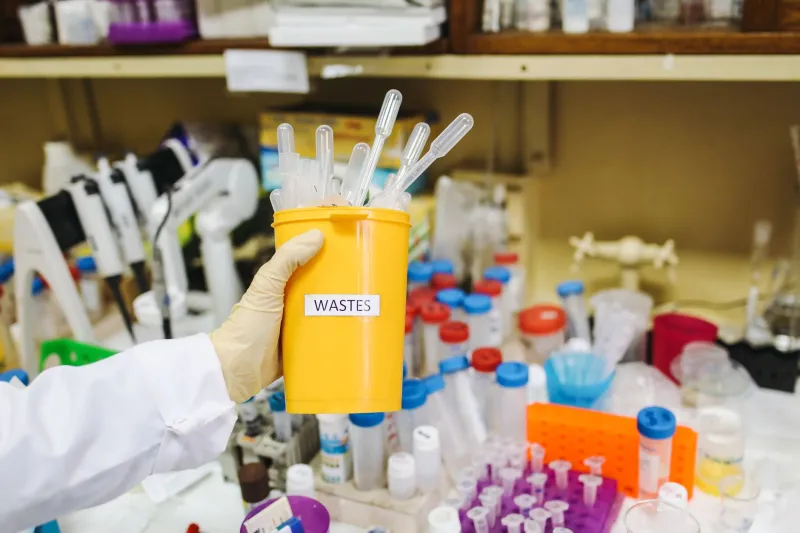
University research laboratories are, by their nature, chemical-intensive environments. The biological sciences rely on fixatives, staining agents, and organic solvents. Chemistry departments generate reaction byproducts and spent reagents spanning the full spectrum of hazard classifications. Medical and public health research produces radioactive isotopes, biological specimens, and pharmaceutical compounds. Engineering programs work with heavy metals, nanomaterials, and industrial lubricants.
The aggregate volume of hazardous waste generated by a major research university is substantial. According to data submitted to the EPA under the Resource Conservation and Recovery Act, large-quantity generator universities—those producing more than 2,200 pounds of hazardous waste per month—include some of the nation's most prestigious academic institutions. The regulatory framework governing this waste is not inconsequential: RCRA establishes storage time limits, disposal standards, and manifest requirements that, in principle, ensure accountability.
In practice, however, compliance is uneven, oversight is episodic, and the communities most likely to be affected by disposal failures are those least equipped to monitor or challenge institutional behavior.
Who Bears the Burden
The geography of university hazardous waste management is not neutral. Research institutions in major metropolitan areas—Boston, Chicago, Baltimore, Houston—are frequently situated in or adjacent to neighborhoods with significant populations of color and lower median incomes. When waste transport routes, storage facilities, or disposal contractors fail, the consequences are not distributed randomly. They fall on the people who live nearest to the failure point.
This is environmental justice in its most concrete form: the differential exposure of vulnerable populations to environmental risk as a consequence of decisions made by more powerful institutions. It is a dynamic that environmental science researchers analyze extensively in industrial and extractive contexts. It is analyzed far less frequently when the institution generating the risk is an academic one.
The workers who handle hazardous materials within university buildings deserve equal consideration. Laboratory custodial staff, facilities maintenance workers, and chemical waste handlers are disproportionately drawn from communities of color and immigrant communities. They often lack the educational background to fully interpret safety data sheets, may face language barriers in accessing training materials, and occupy institutional positions that limit their practical capacity to refuse unsafe work assignments. The occupational health dimensions of university hazardous waste management are, in this sense, inseparable from its environmental justice dimensions.
The Regulatory Gap and the Institutional Incentive Problem
Universities occupy a peculiar regulatory position. As non-profit educational institutions, they benefit from certain exemptions and reduced scrutiny that would not apply to commercial chemical manufacturers generating equivalent waste streams. State environmental agencies, already resource-constrained, often prioritize inspections of industrial facilities over academic ones. And universities, as significant employers and economic anchors in their communities, exercise political influence that can shape the regulatory environment in their favor.
The result is a system in which the institutions best positioned to understand the environmental consequences of inadequate hazardous waste management face the weakest external pressure to improve their practices. The incentive structure runs in the wrong direction: robust waste characterization increases regulatory burden, transparent reporting creates reputational risk, and the communities most affected lack the institutional leverage to demand accountability.
This is not to suggest that all universities manage their hazardous waste irresponsibly. Many maintain exemplary environmental health and safety programs staffed by dedicated professionals. But the existence of best-practice outliers does not resolve the systemic problem, and the absence of consistent, rigorous, publicly accessible data on university hazardous waste management makes it impossible to distinguish high-performers from low-performers with confidence.
The Contradiction at the Heart of Environmental Academia
What makes this situation particularly acute is the nature of the research being conducted in these laboratories. Environmental toxicologists studying the health effects of industrial chemical exposure. Hydrologists modeling groundwater contamination plumes. Environmental justice scholars documenting the relationship between institutional power and pollution burden. These researchers are, in many cases, generating the very evidence that indicts the institutional practices of their own employers.
The academic norm of separating scholarly inquiry from institutional critique has its legitimate purposes. But when the subject of scholarly inquiry is the harm caused by institutions structurally similar to one's own, that separation becomes intellectually untenable. Environmental scientists who study pollution externalities have a particular professional obligation to examine the externalities of their own research enterprise.
This is not about assigning individual blame to researchers who are, in most cases, working within systems they did not design and cannot unilaterally reform. It is about recognizing that the collective silence of the environmental academic community on this issue is itself a form of complicity—and that breaking that silence is a prerequisite for meaningful change.
What Accountability Actually Looks Like
Serious institutional accountability in this domain would involve several interrelated commitments. Universities should publicly disclose their hazardous waste generation data by department and waste type on an annual basis, in formats accessible to non-specialist community members. Environmental health and safety offices should be adequately funded, staffed with professionals who reflect the diversity of the campus community, and structurally insulated from the administrative pressures that can compromise their independence.
Community advisory boards—composed of residents from neighborhoods adjacent to campus, not just university-affiliated stakeholders—should have meaningful input into waste management practices and access to monitoring data. Worker safety training should be provided in the languages spoken by the actual workforce, not just the language of the institution's administrative documentation.
Perhaps most importantly, environmental science departments should integrate the study of their own institutional waste streams into their research programs. The analytical capacity exists. The methodological frameworks exist. What has been lacking is the institutional will to turn the tools of environmental inquiry inward.
The environmental justice principle that affected communities must have a voice in decisions that shape their environmental exposure applies to universities as fully as it applies to chemical plants and oil refineries. Acknowledging that equivalence is not comfortable. It is, however, necessary.